Tuesday, March 09, 2010

American Soul


American Soul


Hey everybody, if you've been around here awhile, you already know what a big fan I am of the music that was recorded at the American Sound Studio in Memphis. From #1 hits on people like Elvis, B.J. Thomas and Neil Diamond to obscure B sides by some of our favorites like Sir Lattimore, Roscoe Robinson and Sam Baker, the American Group gave it their all. The most versatile of any of the great Memphis studio bands, I continue to discover them again and again on great records that I've played for years. Whether produced by their own Chips Moman and Tommy Cogbill, or by outsiders like Buddy Killen, Papa Don Schroeder and Tom Dowd (to name a few) the music they created there continues to intrigue and amaze me.

There's been a couple of exciting new developments recently, and I wanted to share them with you...

First off, Erick Crews, whose father Don was the co-owner of the studio with Chips, has started up a Facebook Group called Chips Moman & Don Crews' American Sound (Recording) Studio. As much as I had resisted joining Facebook in the past, it's things like this that make it all worthwhile. Erick has collected some fascinating photographs, news clippings and memorabilia, and more are being added everyday. The group counts Spooner Oldham, Gene Chrisman and Bobby Wood among over 240 other members, and it's great hearing what they have to say. This is truly a phenomenal resource, folks, with the potential to become even better. Come join us!


Also, the long-awaited Memphis Boys: The Story of American Studios has just been released by the University Press of Mississippi.

Written by Roben Jones, the book takes the reader inside the day to day operation of the studio using actual session logs kept by Reggie Young and Bobby Emmons. How cool is that? Roben fell in love with the American Group's music as a young girl, and has been collecting it ever since. As she told Allen Smith over at Soulful Music, "One Saturday morning in April 1969 I heard on the radio the Box Tops version of I Shall Be Released. I was fourteen. To this day I can't describe how affected I was by that record. It wasn't the song so much as it was the production... Tommy Cogbill and Chips Moman had woven the music so creatively around this Bob Dylan tune that they had transformed it into a statement of their own. It was just such an original concept. It made me aware of the producer's role in making a great record..." Roben went on to become a published poet, and brings those unique sensibilities to the writing of this book. A 'labor of love', she began the project way back in 2002.

Roben was kind enough to speak with me last week:


Memphis Boys: The Story of American Studios is now available at Amazon.

Now, I first put together the American Soul mix we have here back in January of 2008 when I was working on the Chips Moman Story, and put it out there on the late lamented Soul Detective Podcast. Shortly after that, the Podcast thing was taken down because of some 'terms of service' violation or something... anyway, I thought maybe a lot of people hadn't heard it so I'd re-post it here on the main page. Let's take a look...

Joe Tex - Skinny Legs And All (Dial 4063) 1967 - a top ten pop hit (#2 R&B), they say that Reggie Young's incredible guitar lick actually knocked Joe down on the floor!

Arthur Conley - Funky Street (ATCO 6563) 1968 - Just four months after Otis died, Tom Dowd took Arthur into American and produced this high energy stomper... check out those handclaps!

King Curtis - Cook Out (ATCO 6534) 1968 - The flip of the King's cover of a Buffalo Springfield song, this one picks up where 'Memphis Soul Stew' left off... 'we call that dinner on the ground'

Bobby Womack - I'm Gonna Forget About You (Liberty 56186) 1970 - Actually recorded two years earlier for the amazing My Prescription LP, it was written by Womack's mentor Sam Cooke and produced by Moman, they just don't come much better than this, y'all!

Roscoe Robinson - How Many Times Must I Knock (SS7 2618) 1968 - That's Womack on the guitar backing up the man who introduced him and his brothers to Sam in the first place. Check out Tommy Cogbill working that bass! Lord Have Mercy!

Soul X 2 - It's Alright Now (SS7 2612) 1968 - Another great J.R. Enterprises production, this time on former Soul Stirrers guitarist LeRoy Crume and Pilgrim Wonders' Calvin April's attempt at crossing over. Just another example of how great this band was.

Sam Baker - Sugarman (SS7 2620) 1968 - John R took Monument songwriter Kris Kristofferson's noir street tale to Chips and cut it on our friend Sam Baker. I love the horn arrangement...

Don Covay - Never Had No Love (Atlantic 2440) 1967 - Produced by Cogbill, this one just kills me. Reggie Young's guitar is just unbelievable, man. How great is Don Covay?

Solomon Burke - Meet Me In Church (Atlantic 2527) 1968 - You already know how I feel about this one... it still kills me every time I hear it. A Tom Dowd production of an Arif Mardin arrangement, Reggie's guitar is, once again, amazing.

Oscar Toney Jr. - For Your Precious Love (Bell 672) 1967 - Here's the top 5 hit that Papa Don cut on Oscar in one take down there on Thomas Street. It will live on forever.

Wilson Pickett - I Found A True Love (Atlantic 2558) 1968 - When Jerry Wexler sent Pickett to American, he teamed up with Bobby Womack to cut some of the best records ever made. This is one of them!

The Masqueraders - Love, Peace And Understanding (AGP 122) 1969 - Finally on their own, Tommy Cogbill produced this simply fantastic 45 on this most under-appreciated of all vocal groups for American's own label.

As great as these records are, they are only beginning to scratch the surface. The depth and quality of the music that was created at American Sound just boggles the mind.

I'd like to take this opportunity to thank Chips Moman, Tommy Cogbill, Don Crews, and all of the Memphis Boys for that... you guys are the greatest!

Monday, March 29, 2010

The Soul Clan - That's How It Feels (Atlantic 2530)


That's How It Feels

An American Single?


In Sweet Soul Music, Peter Guralnick said "...the singers never did get to actually meet in the studio... but instead recorded their vocals separately to a backing track which Covay had put together with Bobby Womack at the Wildwood Studio in Hollywood."

In Nowhere To Run, Gerri Hirshey said "...one session... was actually cut in Nashville in February 1968, yielding... Soul Meeting and That's How It Feels."

Hmmm... although I've never actually featured either side of this awesome 45 here on the site, I have spoken about it a number of times:

5/1/06
An idea that Solomon and Don Covay had been working on for some time, The Soul Clan, had finally begun to take shape in 1967. The idea was for all of these great performers to pool their talents and resources, and become a positive force within the black community. They envisioned things like buying ghetto real estate and refurbishing it, providing jobs, building schools, and creating black-owned restaurant franchises that would knock the McDonald's and KFCs out of the box... the possibillities were endless.

Originally, it was to include Otis Redding, Wilson Pickett, Joe Tex, Solomon, and Don Covay. When Otis died in late 1967, Pickett backed out as well saying, "I got my own hit records, I don't need that shit!". They were replaced with Redding's sidekick, Arthur Conley, and former Drifter Ben E. King. Covay put together the backing tracks out in L.A., and each of the artists overdubbed their vocals in turn. The resulting single hit the charts in July of 1968, and climbed to #34. At this point, Solomon Burke claims, "The record was stopped and banned...we were going against the grain of what black entertainers are supposed to do. We were all just supposed to go out and buy red Cadillacs. We weren't supposed to go out and start talking about spending millions of dollars on building and developing... We were supposed to talk about having parties and good times and eatin' barbecue ribs. You know, pork chops."

9/19/06
Don Covay and Bobby Womack had put together the backing tracks for the long-awaited Soul Clan single out in L.A., and Atlantic had each individual artist record his vocals whenever they were available. After Wilson Pickett balked, and Otis Redding went and died on them, they arranged for Ben E. King and Arthur Conley to replace them. Conley recalled that he never even spoke with the other members of the Clan about the record, and that he recorded his part all alone up in New York. The single would go to #34 R&B in the Summer of 1968, and then, according to Solomon Burke, "the record was stopped and banned". He may have been right.


10/6/06
Joe had cracked the top ten with both of his releases (Skinny Legs And All and Men Are Gettin' Scarce) just prior to the issue of the Soul Clan single in June of 1968. He was, arguably, the hottest star on there at that point, and would continue his success on the charts well into the seventies - something his fellow Clan members would be unable to do... In 1981, there were big plans for a Soul Clan reunion, complete with a world tour and a new album. At a press conference in New York in July of that year, Joe told author Gerri Hirshey "It ain't gonna work... We are five different men. Most of us are loners... a soul man is that, singular... As far as I can see, the future of the Soul Clan died with Otis Redding." As it turned out, he was right, the single concert held in NYC that summer was a disaster, and the rest of the plans failed to materialize.

4/16/07
I know we've talked about The Soul Clan before (in our Solomon Burke, Joe Tex, and Arthur Conley posts), but it's important to remember that the whole thing was Don Covay's idea. He was the one spinning the elaborate aspirations, daring to imagine a world in which Black Americans could control their own destinies. According to Solomon Burke, they had initially asked Atlantic for a million dollar guarantee up front, and the project was to include a complete album of material. The Clan was reportedly waiting for Otis Redding to fully recover from minor throat surgery when he died in that infamous plane crash in December of 1967. Covay, more than ever now, was committed to making his dream come true. He wrote and recorded the basic tracks of the single out in Hollywood with (an uncredited) Bobby Womack, and the rest of the Clan overdubbed their vocals as their schedule permitted. Arthur Conley, of course, would replace Otis, and Soul Meeting broke into the R&B top 40 in the summer of 1968. Although a great record, the Soul Clan's moment seemed to somehow already have passed. Whether it was due to a conscious decision on the part of the Atlantic brass (as Covay and Solomon Burke believe to this day) or not, that would be the end of that...

Well, I think we were all wrong.

As I mentioned over on the other side, it has been my intention to continue the work I started with the American Soul mix, and focus on some great singles that were cut at American Sound that may have never gotten the attention they deserve. Like I said in the interview thing with Roben Jones, I continue to discover the work of these amazing musicians on records I've listened to for years, with today's selection being, perhaps, the most glaring example... let's do the math:

If the backing tracks were indeed cut in February of 1968 (which seems about right as the single was released in July, and it probably would have taken that long to get all of those separate vocals on there), that was precisely the period when Atlantic was ensconced down there on 827 Thomas Street, with Tom Dowd cutting both Arthur Conley and Solomon Burke there the following month. Buddy Killen cut all of Joe Tex's records there. Bobby Womack was living in an apartment in downtown Memphis, and had become one of 'the Boys' cutting his breakthrough Fly Me To The Moon LP at roughly the same time. Don Covay, who lived in St. Albans out here on Long Island back then, had been cutting at American since August of 1967.

The Atlantic Records Session Index for 1968 had this to say:

Note the question mark... and

Which would seem to indicate that Covay worked on finishing the project in New York, near where he lived. It certainly seems a stretch to think that both Covay and Womack wound up in Los Angeles right in the middle of all of this...

And so it is my considered opinion, my friends, that this much revered and talked about 45 (with it's way cool intro that puts you in mind of Conley's Burning Fire) was indeed an American Single. What do you think?

Monday, February 25, 2008

The Masqueraders - Tell Me You Love Me (AGP 122)

Tell Me You Love Me

PART THREE


This 'trade' ad from early 1969 is kind of like the Rosetta Stone... the key to understanding where Chips Moman and American were at during this period.

If you notice, Tommy Cogbill has been promoted to the 'Executive Board', along with Chips and Don Crews. He had pretty much put down his bass by then, and Mike Leech (who, according to Papa Don, could "imitate Tommy's style to a T") had taken over.

Dan Penn had finally convinced Spooner Oldham to leave Fame and join him at American in early 1968. They put their heads together and came up with yet another smash hit for Alex Chilton and the Box Tops, Cry Like A Baby, which spent almost four months on the charts, including two weeks at #2 Pop (only kept from the top slot by Otis Redding's Dock of the Bay!). Despite that fact (or, as we've seen, maybe because of it), there was no room on the Board for Penn.

Instead, he's listed along with Oldham as one of the staff songwriters for what must have been their in-house publishing company, Press Music. Penn told Guralnick that by mid 1969, Chips told him "Get in or get out" to which he replied "I'm Gone," and opened up his own studio, Beautiful Sounds, which apparently never amounted to much (a fact which Dan attributes both to the assassination of Martin Luther King, Jr. and the arrival of marijuana on the Memphis scene...). In any event, Chips had succeeded in driving him away.

Cogbill became his new production partner, and a record they cut on a Seattle folk singer busted things wide open in the summer of 1968. Although Angel Of The Morning only hit #7 on the US charts, it apparently made number one in seven foreign lands. It was huge, and the possibilities seemed limitless for Merrilee Rush and her band The Turnabouts. Chips used his new found leverage with Bell to establish his own 'American Group Productions' and get them to place his AGP logo on future releases.

Around this same time, a Texas vocal group that had grown tired of getting nowhere up in Detroit showed up at American. According to Heiki Suosalo's in-depth article at Soul Express, they were on their way to Stax, but stopped over at American on the way. When they got there, "Bobby Womack said 'let me hear what you guys got'. So we did a couple of songs for him, and Bobby and Darryl Carter liked them. Bobby said 'look, there's no need for you guys to go over to Stax. Why don't you just stay right here at American, cause you've got a great opportunity over here'... Bobby... told us that we'd probably get lost in the shuffle over at Stax, because they had so many artists on their roster but they really didn't have that many artists at American. So we stood a better chance making it there. We took his advice and stayed. After we auditioned to Chips, he gave us a contract.”

In addition to providing back-up vocals for most everybody from then on, The Masqueraders were also excellent songwriters, and quickly became a part of the team. With Tommy Cogbill as their producer, their first Memphis efforts were leased to Wand up in New York (who had become one of American's best customers by then), an arrangement that Larry Uttal wasn't too happy with. He would release their next single himself on Amy, only he had to change their name to Lee Jones and the Sounds Of Soul. In any event, after one more Wand 45, he got his way, and signed them to Bell.

It turned out to be a pretty good deal, as it gave the Masqueraders their first chart hit after literally years of trying. I Ain't Got To Love Nobody Else would make it to #7 R&B in the fall of 1968, and spend over three months on the charts. With 'AGP' appearing on the label in letters as big as 'Bell', it set the stage for what Chips had wanted all along, his own record label. Jerry Wexler has made no secret of the fact that he was pissed off that Moman didn't choose Atlantic as his distributor (after he had loaned him the $5000 to upgrade American's equipment), and went with his nemesis Uttal instead... a fact which no doubt helped set in motion Wexler's exodus to Criteria in Miami later on.

One of the first artists to record for the new label was Sam Hutchins. The Masqueraders had met Sam back in their home town of Dallas, and just loved his voice. He had been traveling with the group as an opening act at their performances, and when they got to Memphis Chips was impressed as well, signing him as a solo artist. After one release on Mala, he would cut two great singles for AGP (one of which is now up on The A Side), with the Masqueraders providing both the material and the back-up vocals.

The AGP roster included some colorful characters, like football great Roosevelt Grier, who would record some Masqueraders penned material for them, as well as fabled vocal group The Ad-Libs, who had the inaugural release on the label. Mark James (the 'Press Co.' writer who had given Suspicious Minds to Elvis after his own version of the song went nowhere) would produce local garage legends Butterscotch Caboose for them, and Chuck Brooks, who would go on to create some great records with Homer Banks and Randy Brown, cut one of AGP's most sought after releases, I've Got To Get Myself Together.

There would also be three singles by The American Group themselves, including the way cool Enchillada Soul, which was penned by Bobby Womack and our man Rosy Grier(!). As the only recordings this great band made under their own name, these 45s are next to impossible to find and, when they do show up on eBay, go for big bucks (a situation which will probably get even worse now that I've opened my big mouth!). Oh well.

If you take a look at the 'American Group' photo from the Rosetta ad, you'll notice a member of the band that never seems to get mentioned, Ed Kollis. As the studio's official harmonica player, he's featured on some great records (Joe Tex's Skinny Legs and All comes to mind). I wonder whatever became of Ed? I'm not sure what kind of deal Moman made with Uttal, but it seems pretty amazing that the larger company consented to let AGP handle future 'product' on one of its hottest stars at that point, Merrilee Rush. After her follow-up on Bell only made it to #79, she became an AGP artist, with only one of her four singles for the label cracking the Hot 100. I don't know if Bell was actively 'selling' AGP releases, or what, but it sure doesn't seem that way.

The same could be said for The Masqueraders. After two more Bell releases failed to chart, Uttal consented to them signing with AGP. I'm Just An Average Guy would hit #24 R&B in early 1969, and become the label's biggest hit, but their two subsequent releases went nowhere. Today's smooth selection, the flip of the awesome Love, Peace and Understanding (which closes out our recent American Soul mix) just kills me. An incredible vocal performance of a song they wrote themselves, I think it shows just how talented these guys were. Tommy Cogbill's production on both sides of this record is simply impeccable, and is something he never seems to get credit for. Just great stuff, y'all! [I just found out that The Masqueraders, who now count Sam Hutchins as a member, play at the Blues City Café on Beale Street in Memphis every Friday night.. Wow!]

Another unbelievable signing that AGP made was R&B great Roy Hamilton. His legendary cover of Dark End Of The Street just drips with Soul but, predictably, none of his three AGP singles made much noise. Roy was recording at American at the same time as Elvis, and they split the sessions, with Hamilton cutting in the morning, and Presley in the afternoon. Imagine? Sadly, Roy died in New York shortly thereafter due to complications from a stroke. He was only forty years old. I'm not sure what happened after that, but AGP ceased to exist as a label by early 1970, after only 26 releases. It could be that Bell (who chose to record new signee Solomon Burke at Fame in 1969) had moved on by then, I don't know. By 1971, though, Atlantic was no longer a client, and Chips was becoming increasingly aggravated at what he saw as a lack of appreciation there in the Bluff City. After something called the 'Memphis Music Awards' completely ignored his studio and its unparalleled string of hit records two years in a row, he couldn't take it anymore, and he closed American down for good in 1972.


You see those two little pictures up there? As far as I can tell, they are the only photographs that exist of this landmark studio. The color one was taken in 1985, after most of the letters had fallen off of the sign. The building was demolished sometime in the nineties, and 827 Thomas Street is a litter-strewn vacant lot today... what a shame. You know, when you visit Memphis, it's hard not to notice the busloads of tourists that Graceland ferries over to Sun... and, after seeing what Stax has done with a rebuilt facsimile of their own bulldozed studio, it's not much of a stretch to envision an 'American Museum' on the corner of Chelsea and Thomas. The Elvis traffic alone would pay the bills. Now, wouldn't that be something?v I'd be their first visitor!
...continued in Part Four

Monday, June 20, 2011

The Kingpins - In The Pocket (ATCO 6516)


In The Pocket

GET EXCITED

I'm heading out on a Road Trip the end of this week to attend the sold out Memphis Boys concert at the Franklin Theater in Franklin, Tennessee. I am just so like amped, bro! Woo-Hoo! They are, without question, the most under appreciated of the Southern Soul 'rhythm sections', but somehow it's just not cool (perhaps it's even considered a sacrilege) to say that they were the best. What's that, Red? Better than the MG's, you say? Better than the 'Swampers'? Better than Hi Rhythm?

Yes.

There, I've said it... this absolutely untouchable B side we have here today is a case in point. Cut in August of 1967, the staggering amount of talent in the building at 827 Thomas Street at that moment just boggles the mind. Tom Dowd and King Curtis showed up with a young bass player named Jerry Jemmott, which freed up Tommy Cogbill to co-produce the sessions with Dowd, resulting in some of the best music ever recorded at American. In addition to all of that, Bobby Womack had just recently arrived and decided to stay a while, composing this incredible song with King Curtis on the spot. They honestly don't come any better than this, folks! This was the first recording credited solely to The Kingpins, the group that Jemmott would continue to anchor for Curtis for years, only in this case it's really the American Group with Jemmott and Womack along for the ride. So, who's playing that towering, shimmering, utterly fantastic electric guitar - Reggie Young, Bobby Womack, or both of them? Hmmm...

In any event, this record shows just how tight a band these guys were, and how, as I said, they continue to turn up in the most unexpected places. Reggie, of course, came up out of Bill Black's Combo, and was the cornerstone of Hi Records for years, playing on virtually every record cut at Royal Studio before Willie Mitchell brought in Hi Rhythm in 1968. It was a studio band that would also include Bobby Emmons, Tommy Cogbill and Mike Leech at one time or another, and whose influence on Memphis Soul is simply incalculable.

You know, I've put up almost 600 45s since I started this thing almost six years ago, and I got this idea to go through them and pull together every one of 'em that featured The Memphis Boys in one form or another. Here goes:


Willie


Woodchopper's Ball


I'll Do The Rest


Prayer Meetin'


Forgetting You


Old Friend


Crying Baby Baby Baby


The Dark End Of The Street


You're Gonna Make Me Cry


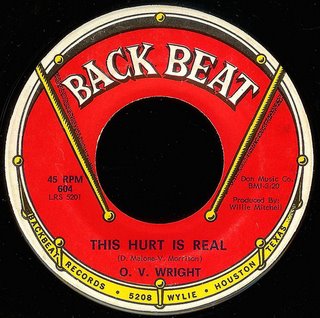
This Hurt Is Real


Missing You


I Want Everyone To Know


I Was Born All Over


Ain't That True Love


I Don't Want To Have To Wait


Cry Like A Baby


Don't Look Back


Nobody Has To Tell Me (You Were Meant For Me)


One Bo-Dillion Years


(You Keep Me) Hangin' On


I'm Alright Now


Comin' To Bring You Some Soul


Everyday I Have To Cry Some


How Many Times Must I Knock


Show Me


Temptation Was Too Strong


Somebody's Got To Love You


Cheater Man


I'm Blue


Save It


Meet Me In Church


Memphis Underground


New Orleans


So Much Love


This Is Soul


8th Wonder


Burning Fire


People Sure Act Funny


Hey Little One


The High Times


I'm Tired Of Pretending


Tell Me You Love Me

When I started working on this post, I honestly had no idea how many there really were. Wow! Even when taken with the earlier American Soul Mix that I posted a few years back, these records only begin to tell the story of this greatest of all Southern Soul rhythm sections.

As their work with more mainstream artists like B.J. Thomas and Neil Diamond began to bring some well deserved attention to American, things began to change... Once the King entered the building in January of 1969, there was no turning back.


Any Day Now

Here's the number one smash hit that sealed the deal. Arguably Chips and the Boys greatest work, it represented a high water mark that was tough to top.


Suspicious Minds

Don't get me wrong, I'm not saying that these guys don't deserve all the accolades they've gotten over the years for being the force behind the well documented Elvis Resurrection, I just feel that these kudos tend to obscure the amazing wealth of music that got them there... and just how exceptional they really are.

After the move to Nashville, they continued to be used as a cohesive studio unit on great R&B records like this one by folks like Papa Don Schroeder and Buddy Killen...


I Wanna Be Your Main Squeeze

...and as Chips got down to business in Nashville, and brought his own unique gift to the Outlaw Country movement in the mid-seventies, he brought Reggie and the Boys along with him as well.


Just To Satisfy You

There is no other band with as varied and consistently excellent output, period.


The Memphis Boys stand alone.