Wednesday, September 26, 2007

James Carr - Forgetting You (Goldwax 311)


Forgetting You

Now let's move on to that other vocalist that knocked on Quinton Claunch's door that fateful night in 1964... a man some say was the best soul singer of them all, James Carr.

Carr's story, as a subplot of the whole Goldwax saga, remains one that captures the imagination. It's a tale of madness and 'personal demons', of a twisted and tortured interior struggle that would plague James his entire life... a tale of how that chaos was redeemed in the timeless body of work that he created in just a few short years - a body of work that includes, in my opinion, the greatest song ever recorded.

A simple man who, some say, never learned to read or write, Carr grew up in Memphis singing in local Gospel quartets like the Harmony Echoes. His first record for the label, You Don't Want Me (Goldwax 108), was pretty much a straight-ahead Blues number that was recorded around the same time as O.V.'s big single. The flip of that record, Only Fools Run Away, although kind of like an over-produced Arthur Alexander tune, gives a glimpse of the vocal power that was to come. Lover's Competition (Goldwax 112) would follow, and essentially mine the same syrupy territory without much luck.

By 1965, things were really starting to happen down there in 'Soul City U.S.A.', and Goldwax found itself in the right place at the right time. Claunch's connections in the local music scene began to pay off, especially his friendship with former Sun pedal steel man turned engineer, Stan Kesler. Stan (pictured here with Claunch and Doc Russell) worked the board over at the Sam Phillips Recording Service, the state-of-the-art studio Phillips had set up in 1959.

It was Kesler, they say, that first put together the incredible rhythm section that would later become the 'house band' at Chips Moman's American Studio. Goldwax had no studio of their own, and so booked time wherever they could find it. Carr, as I understand it, was recorded primarily at Sam Phillips, using that core group of Reggie Young, Bobby Emmons, Gene Chrisman, Tommy Cogbill, Mike Leech, and Bobby Wood. Wherever it was that they were rolling the tape, things really began to come together for Carr and the label. Goldwax 119 paired the upbeat Talk Talk with the great She's Better Than You, a song written by a kid named O.B. McClinton.

McClinton had been with the label almost since its inception, and Goldwax had released his own version of the song the year before. Like the personal embodiment of the company's sound, O.B. was a black man who wrote, and performed, Country music. He had been raised in Mississippi and, by his own recollection, had fallen in love with the sound of Hank Williams on the radio when he was a kid. Still a student at Rust College when fellow songwriter Earl Cage brought him to Claunch's attention, he would go on to write some of Carr's best material. McClinton, after recording for Stax subsidiary Enterprise in the early seventies, later became known as The Chocolate Cowboy, breaking down all the barriers as he appeared some fifteen times on the Billboard Country charts before his untimely death in 1987.

It was McClinton who delivered James' first hit, the great You've Got My Mind Messed Up, which would spend two months on the charts, breaking into the R&B top ten in the spring of 1966. The follow-up, Love Attack (penned by Claunch himself, who had become quite the songwriter), hit #21 that summer, and James was on a roll. This was also around the time that Claunch signed on with Larry Utall, whose New York based Bell Records now became the Goldwax distributor.


As I'm sure you know, Peter Guralnick spoke about all of this at length in his ground-breaking work, Sweet Soul Music. Particular attention was paid to the relationship between Roosevelt Jamison and our man James. Jamison had become his confidant, mentor and manager, and saw him as "pure clay to be molded." Once Utall began moving some serious product on him, he convinced Goldwax to fire Jamison, and place Carr with Walden Booking, the mega-agency created by Phil Walden that managed Otis Redding, and just about everybody else in those days. In the book, Jamison says "They didn't know how he actually felt... how hard it was coming from the bottom, from nothing to something so fast. It was like coming from four or five years old to twenty five all of a sudden... within six months he came tumbling all the way down." Be that as it may, it is precisely that period of turmoil that would produce his greatest work.

Today's unbelievable selection was released as the flip of the upbeat mover, Pouring Water On A Drowning Man, which would cruise to #23 R&B in the fall of 1966. Written by McClinton, it's basically a Country record all the way... that is until the last thirty seconds or so, when the band (led by that incredible Reggie Young guitar*) shifts things down to a minor key, then just builds and builds... with those trademark Memphis Horns and James' positively primal howls and shrieks. Whoa!! Goose Bumps, man. This is the pure essence of soul music right here, folks, and when you take it in context as the B side of the single before this next one, it seems even better.

What more can be said about Goldwax 317? What could I possibly add to the discussion of this elemental and pure work of art? Not much, I suppose, except to add my voice to those who consider The Dark End Of The Street the best record ever made. Born of a poker game at a Nashville disk jockey convention in 1966 (the same convention, by the way, that got Huey Meaux in all that trouble for providing the 'entertainment'), and written by an unholy alliance of two white guys who were ultimately too much alike to be together for very long, it doesn't seem possible that it was ever written at all. When the board at American blew up the day of the scheduled session, they had to move it across town to Royal at the last minute. The stars were aligning...

What is it that makes this song so great? To tell you the truth, I don't know, but it still moves me every single time I hear it. Perhaps it's the transparency, the palpability of Carr's unique voice... the unguarded window into his soul. As Robert Gordon put it in his excellent article, James Carr: Way Out On A Voyage; "We are not sung to... the performance is not one we witness from the audience but one we feel through him. [Otis] Redding made a gift of his passion, something we could admire from a distance. Carr's passion is reciprocal..." Amen.

It would reach the R&B top ten in early 1967, and be included, along with most of his other singles, in Goldwax' first LP release later that year. It remains one of the most sought after slabs of vinyl out there. Although James would chart five more times for the label (most notably with O.B. McClinton's great composition A Man Needs A Woman, which would also become the title track for a follow-up LP in 1968), it was almost as if he had left it all out there... I mean, how do you follow perfection?

He was a haunted man.

Stories abound about Carr's descent into a bi-polar depressive nightmare. About failed recording sessions and concert tours. About how, after Goldwax threw in the towel in 1969, and his lone Atlantic single died in 1970, he basically could not account for his whereabouts for the next ten years. Attempts were made to resurrect his career. Jamison himself took him to Japan in 1979, on a tour that was destined to fail.

A re-incorporated version of the Goldwax label would record an album on him in 1990 called Take Me To The Limit, and bring him back out on the road to promote it. This was when I saw James at Tramps in New York. The raw power of his voice was still intact. I was blown away.

At the time, though, I don't think I fully appreciated what I was witnessing... a show that Gordon called a "personal and professional triumph," I didn't know it would be one of his last. There is a chilling video of him at Porretta from around this same time on YouTube. Unreal.

He would record one more album, Soul Survivor, for Soultrax in 1994.

James Carr spent the last few years of his life living at his sister's house in Memphis. After losing a lung to cancer, he died at a nursing home there in January of 2001. He was 58 years old.

That's the way love turned out for him.

*please see: https://soulsauce.me/2021/09/30/james-carr-forgetting-you/

Tuesday, October 16, 2007

Spencer Wiggins - Walking Out On You (Goldwax 312)


Walking Out On You

Let me start out here by talking a little bit about the man known as the 'Jackie Robinson of Radio', Nat D. Williams.

A graduate of both Columbia and Northwestern, Williams began writing a newspaper column about African-American issues way back in 1931. Soon nationally syndicated, his name was known throughout the black community. Faced with bankruptcy, an AM radio station in Memphis made the landmark decision to change its format from Classical to R&B, and hired Williams as the first black dee-jay below the Mason-Dixon line. His 'crossing of the color-line' in 1948 proved to be a brilliant idea, as WDIA soon became immensely popular, and proved that 'race music' was indeed commercially viable. Nat's legendary 'Tan Town Jamboree' became one of the most listened to shows in the South, and paved the way for WLAC's white imitators. Williams continued to write his column, and was the man who initiated those fabled 'amateur nights' at the Palace Theater down on Beale Street.

In addition to all of this, Williams was also the much loved History teacher at Booker T. Washington High School in East Memphis. One can only imagine how cool it must have been to have a genuine celebrity for a teacher, as he led an entire generation by quiet example, instilling in them the concept that anything was possible, even in the segregated south. A list of his students reads like a 'who's who' of Memphis Soul - Rufus Thomas, William Bell, Booker T. Jones, David Porter, 'Bowlegs' Miller, Maurice White, Louis Williams, Andrew Love, J. Blackfoot... the list goes on and on. This may have been where Nat Williams had his greatest influence after all, inspiring young people to go forth and create. They say he never missed a show in all his years on WDIA, until he was felled by a stroke in 1972. Just a wonderful man, he passed on in 1983, and is fondly remembered by all who knew him.

Williams taught two brothers who were coming up in those days, inseparable and willing to sing at a moment's notice, they were named Percy and Spencer Wiggins.

[As you may know, Ace released the excellent Spencer Wiggins - The Goldwax Years in April of 2006. The exhaustive and comprehensive liner notes were written by Colin Dilnot, who has been kind enough to post them at his excellent Keeping Soul Alive page. A result of years of painstaking research and some hard-won interviews, they remain the definitive authority on all things Wiggins. What follows is my own feeble attempt to summarize those notes. Thank You, Colin!]

Growing up in a religious family, both Percy and Spencer were singing along with their Mother in the choir of the New Friendship Baptist Church while they were still in grade school. Before long they had formed their own group, The New Rival Gospel Singers, which would also include their sister, Maxine. They became a local sensation, and even had their own 15 minute radio spot on WDIA. As they entered High School, their passion for singing remained intact, and both boys became members of the Glee Club. They continued to sing Gospel as well, as part of the Southern Junior Wonders, emulating the quartet sound of the elder group. The Wiggins brothers loved R&B as well, and formed a vocal group called The Four Stars that performed in local talent and variety shows.

Upon graduating from High School, the brothers set their sights on individual careers as R&B singers on the hot Memphis club scene. Spencer held down a long time gig at the Flamingo Room, and was often joined onstage by Percy singing Sam & Dave style duets. Quinton Claunch, on the lookout for talent for his new label, caught his show one night and offered Spencer a contract in early 1965. For whatever reason, his first release for Claunch was on the Bandstand USA imprint, apparently a planned subsidiary of Goldwax that never left the ground.

As we've seen, it's difficult to nail down exact studio and session details with Goldwax, as they moved around a lot, but Spencer's first release on the main label was the excellent Penn/Oldham gem Take Me Just As I Am (Goldwax 308) in 1966 (a song which Solomon Burke would take to #11 the following year). Judging by the unmistakable Reggie Young guitar, It appears to have been one of the first records Dan Penn worked on after he made the move to Memphis. In any event, it's a great version, and showcases the full range of Wiggins' incredible voice, which is kind of like a mixture of Wilson Pickett's, Bobby Bland's, and Johnny Adams' (if that makes sense).

Spencer had known George Jackson for years before Claunch hired him as a staff songwriter in 1966. The two men understood each other, and worked together for hours at Jackson's mythic broken down piano, writing songs that were custom made for him. That chemistry is obvious in Wiggins' next release for the label, a record some consider to be his best, Old Friend (now up on The A Side). This cookin' blues number you're listening to now was released as the B side of that single. A rough and tumble R&B shakedown, Jackson wrote it, I'm sure, with Spencer's club act in mind. This was just the sort of number to get things going, and the band sure is kicking it there towards the end! Strut 'dat stuff, y'all! What a great record... with a bit of B.B. King creeping into his amazing vocal performance, Wiggins shows that he can belt it out with the best of 'em!

You know there must be something to this whole distribution thing, as Spencer's blistering 1967 version of Uptight Good Woman (Goldwax 321), yet another fantastic Penn/Oldham (and Jimmy Johnson) tune, failed to make the charts, while Chess was able to take Laura Lee's version into the R&B top twenty later that year. On the other hand, Solomon Burke's Fame recorded take on the song became his first release on Bell, and it cracked the top fifty in early 1969. Go figure. The Wiggins version is better than either of them.

A great talent like Spencer's was seemingly 'lost in the sauce' of the Memphis Soul Stew in those days, as Goldwax's blessing (being right there in the thick of things) in some ways proved to be its curse. Maybe there was just too many great singers, or maybe it was their decided lack of promotion. As he told Colin, "Goldwax never put a show together of their stars. This was my biggest problem and why I got lost at Goldwax, I had no one managing me. I was a young man [but] I didn’t know nobody and nobody knew me... I was young and it was down to the fact then that no one was there to guide me and be interested in me. No one ever approached me and said they would like to be my manager. I was right there with Isaac Hayes and David Porter – I came up with them – they were in the right place at the right time – they were with Stax, and Stax was on the move – Goldwax was on the move but we didn’t really have a good distributor at the time.” Apparently so.

After three more singles that didn't do much, Claunch brought Spencer (along with ol' brother Percy) down to Fame in 1969, a point at which the Fame Gang included one Duane Allman on guitar. Wiggins' last release for the label (and fifth to last for Goldwax overall), was a smokin' version of Aretha's I Never Loved A (Wo)Man, that features his trademark slide guitar. Although truly a great record, it died on the vine, as the company would later that year. Rick Hall knew there was more 'in the can' from those sessions and licensed the material from Claunch for release on his own Fame label. Two excellent singles would follow, the second of which, Double Lovin' (Fame 1470), would result in Spencer's only chart appearance when it hit #44 R&B in the fall of 1970.

Wiggins would follow most of the other Goldwax graduates (as we mentioned last week) and sign with the MGM subsidiary Sounds Of Memphis. His lone single for the label, I Can't Be Satisfied, is now the title track of the new Ace CD I told you about. There would be two more releases on XL before Spencer left Memphis and moved to Florida in 1973. Like so many others, he was having trouble making a living singing blues and soul in the clubs and, in 1976, he would return to his Gospel roots and promise God that he would "sing for Him for the rest of my life."

That's just what he's been doing. As a deacon in Miami's New Birth Baptist Church, he leads their music program and directs the choir. After a locally released cassette of songs he had written got considerable airplay on Christian radio down there, he recorded a Contemporary Gospel album called Key To The Kingdom for Tayvette Records in 2002. Known as 'The Florida Gospel Tornado', Spencer Wiggins is still singing his heart out, just as he did growing up in Memphis way back when.

Percy, meanwhile, is still performing R&B in his hometown, where I was lucky enough to hear him sing backed up by Hi Rhythm at the Ponderosa Stomp last year. He was phenomenal. His great Atco single, Book Of Memories, was included on the Atlantic Unearthed collection last year as well.

Enormously under-appreciated, the music these brothers have created has stood the test of time. Nat Williams would be proud.

Wednesday, December 06, 2006

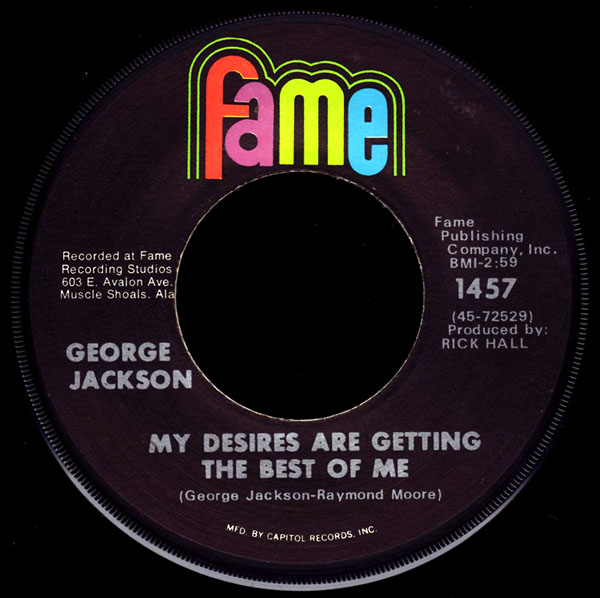
George Jackson - My Desires Are Getting The Best Of Me (Fame 1457)


My Desires Are Getting The Best Of Me

As the final installment of our 'fame fest', I thought we'd focus on the quiet genius behind so much great southern soul, George Jackson.

Born in B.B. King's Indianola, George grew up on the river in Greenville, Mississippi. When Ike Turner rumbled down Highway 61 from Clarksdale, the teenaged Jackson went to see him and showed him some of the songs he'd been writing. Ike was impressed, and brought George downriver to New Orleans to record at Cosimo Matassa's studio in 1963. His idol was Sam Cooke (as he was for most every other aspiring singer in those days), and the record they cut Won't Nobody Cha-Cha With Me was an attempt to cash in on the recent Cooke-inspired 'cha-cha' craze. Released on Turner's Prann label, the single sank like a stone.

Jackson next moved to Memphis, and placed a couple of novelty type singles with the Dot and Doro labels through local impresarios Dorothy and John Hester. Also around this time, he recorded under the first of many pseudonyms, Louie Palmer, for Earl Forrest's Bootheel label in 1965. George's best friend in Memphis, Dan Greer, soon became his songwriting partner, and they formed their own short-lived label, Gre-Jac the following year. The label's only release, You Didn't Know It But You Had Me, was by 'George & Greer', and didn't sell much.

As legend has it, George lived in a big old house in Memphis and the landlady let him use her broken-down piano to write songs. He and Dan would spend most of every day working on material, and they were soon noticed by Quinton Claunch and 'Doc' Russell over at Goldwax Records. Claunch offered Jackson a contract as a songwriter for Goldwax, and one of the first tunes he contributed to the label, Old Friend (You Asked Me If I Miss Her) (Goldwax 312) became a local hit for the great Spencer Wiggins in 1966. In what was apparently part of the deal, Goldwax 313 was a re-release of the George & Greer single. It didn't sell this time either.

George (and Dan) took to their duties at Goldwax, and soon had artists like Wiggins, James Carr, Willie Walker, and The Ovations gathered around the old piano as well, rehearsing the songs they wrote for them. George was a particular fan of Ovations' lead singer Louis Williams, and worked with the group often (although it remains unclear to me if he was ever actually a member). Goldwax didn't have its own studio, and would record whenever and wherever they could get the best deal. It was Dan and George's job to drive the singers to the recording dates, armed with whatever it took (like a bottle) to get the best performance. Jackson became the de-facto producer as well, often running through take after take until he was satisfied with the song. If George was happy, Quinton Claunch was happy too.

George began working with Memphis legend Willie Mitchell around this time, and released So Good to Me on Hi in 1967. Mitchell was able to place a single with Decca the following year, under yet another name - 'Bart' Jackson. A demo George had recorded, Cold Cold Love was released on the Public label in 1968, but he had nothing to do with it.

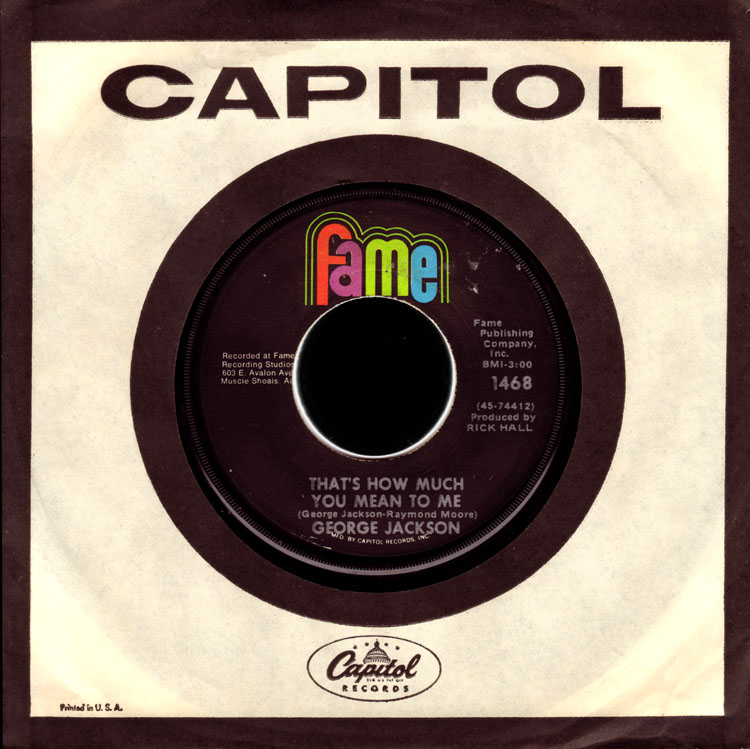
Fame was one of the studios that Claunch had been using off and on, ever since James Carr's earliest sides for Goldwax in 1964. He began sending Jackson down there as well, along with Spencer Wiggins and his brother Percy. They recorded some great material, but Claunch folded the label before it was released. Rick Hall wasted no time, and signed George up as the new staff songwriter at Fame in 1969. Rick also recorded him as an artist for the house label, and today's cool record is The B side of his first Fame single, Find 'Em, Fool 'Em, And Forget 'Em (now up on the A side). Recorded right around the time the 'second' rhythm section left, I'm not sure if it's them or the 'Fame Gang' backing him up, all I know is that it's great! Co-written with his new running partner Raymond Moore, George is at his best here spinning yet another tale of the vagaries of love. His next (and last) single for the label, That's How Much You Mean To Me, would result in his first chart appearance when it cracked the R&B top 50 in the summer of 1970. Hall had secured the rights to the unreleased Goldwax recordings at this point, and when he put out Spencer Wiggins' rendition of Jackson composition Double Lovin' later that year it broke the top 50 as well (Spencer's only chart hit).

When MGM sent floundering boy band The Osmonds down to Fame in 1971, they took a song George had originally written with the Jackson 5 in mind, One Bad Apple, all the way to number one on the pop charts. The record would spend five weeks there, and become an international success (it even made #6 R&B!). The Osmonds were on top. Ironically, their follow-up single would be a cover of Double Lovin', which would make it to #14 pop (Wiggins' original hadn't even 'bubbled under' the Hot 100). MGM would release a George Jackon single on their Verve subsidiary, I Found What I Wanted, later that year, but nothing much came of it.

1972 saw George back in Memphis, working with Willie Mitchell at his Royal Studio. Top 40 R&B hit Aretha, Sing One For Me would become his second Hi release, and George's last chart entry. Another great record, Let Them Know You Care would follow in 1973, but it didn't sell. the B sides of both of these singles, I'm Gonna Wait and Patricia, respectively, are simply wonderful in their own right, and reflective of the phenomenal work that was going on at Royal in those days.

Although George's main focus remained on his songwriting (George Soulé's Get Involved and Clarence Carter's Too Weak To Fight are but two examples of the great work he was doing at the time), MGM continued to release singles on him through 1974. The company also backed a label he had formed with his old partner Dan Greer, Sounds Of Memphis. Back recording former Goldwax artists like The Ovations and Spencer Wiggins, they were producing some great music, but times had changed, and the records weren't selling. MGM promo man Eddie Ray believed in George's talent (even after his employer had moved on), and in addition to placing one single with Chess in 1975, he put out what many consider to be George's finest record, Talking About The Love I Have For You/I Don't Need You No More on his own ER label in 1976.

By the late seventies, George had left Fame and began working with cross-town rivals Muscle Shoals Sound. There was one 'disco' single released on the studio's short lived record label, but the main work was going on behind the scenes. Unknown to the general public, Jackson was hunkered down with what may just have been the best band in the world recording demos of the songs he was writing. The resulting tapes became legendary, and remained unheard for over twenty years (more on that in a moment). His work from this period included blockbusters like Bob Seger's Old Time Rock & Roll in 1978, and James Brown's It's Too Funky In Here in '79.

As we've mentioned before, Tommy Couch and Wolf Stephenson up at Malaco heard George's demos and selected a couple of tunes for their new signee Z.Z. Hill's second album, Down Home in 1981. Jackson composition Down Home Blues, which Malaco refused to release as a single, was just huge and helped make the record the largest selling 'blues' album in history. When they released George's Cheatin' In The Next Room as a single from the album in early 1982, it took off, spending five months on the R&B charts. On the basis of such unprecedented sales, Malaco hired Jackson as their new staff songwriter later that year. He still holds that position today, and has written countless fantastic songs for the label's soul stalwarts like Denise LaSalle, Little Milton, Bobby Bland and Johnnie Taylor (the Jackson penned Last Two Dollars was a gigantic hit in 1996, and helped make Taylor's album Good Love Malaco's biggest seller ever).

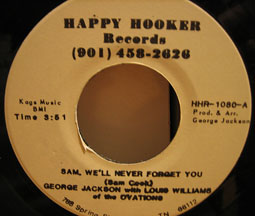
George himself hadn't recorded much in the eighties, except for a few singles on local southern labels like Crosstown and Washataw. He recorded a duet with old favorite Louis Williams for Happy Hooker in 1985, and did some work with good ol' Senator Jones, who had moved his Hep' Me operation to friendlier quarters in Jackson, Mississippi in the early nineties. The Hep' Me material has been made available again on a Black Grape CD, Heart To Heart Collect.

Malaco had bought Muscle Shoals Sound lock, stock and barrel in 1985. George's demo tapes were included in the sale along with hundreds of other items. When Grapevine Music became the UK licensee for Malaco around the turn of the century, they began an ambitious search of their 'vaults'. Finding Jackson's Muscle Shoals demos intact and sounding just as good as the day they were recorded must have been like finding the Holy Grail. They have released two excellent CDs of the material so far, and you should buy them. They are superb.

George Jackson is truly a living legend, and one of the most 'unsung' of the heroes of southern soul. The BMI Reperoire database lists him as the writer or co-writer of 435 songs.

He's A Man And A Half.

Monday, April 15, 2013

George Jackson - I'm Gonna Wait (Hi 2212)


I'm Gonna Wait

George Jackson, in so many ways the pure essence of Southern Soul, has left us. I don't think you can say enough about this man's importance in the development of this music. Known primarily for his incredible songwriting skills, his career as a performer is often forgotten. This emotional gem we have here was released by Willie Mitchell as a B Side twice, once 1n 1967 and again in 1972... that's how good it is. You can feel George put his heart and soul on the line, just as he did with everything he touched. From Memphis and Muscle Shoals, to his longstanding position as the poet-laureate of Malaco Music, George Jackson's gentle genius defined what it meant to be a Soul Man.

He will never be replaced.
____________________________________________

There is an excellent overview of George's recording career over at Deep Soul Heaven, and re-printed below is an appreciation of him I wrote back in 2006:


My Desires Are Getting The Best Of Me

As the final installment of our 'fame fest', I thought we'd focus on the quiet genius behind so much great southern soul, George Jackson.

Born in B.B. King's Indianola, George grew up on the river in Greenville, Mississippi. When Ike Turner rumbled down Highway 61 from Clarksdale, the teenaged Jackson went to see him and showed him some of the songs he'd been writing. Ike was impressed, and brought George downriver to New Orleans to record at Cosimo Matassa's studio in 1963. His idol was Sam Cooke (as he was for most every other aspiring singer in those days), and the record they cut Won't Nobody Cha-Cha With Me was an attempt to cash in on the recent Cooke-inspired 'cha-cha' craze. Released on Turner's Prann label, the single sank like a stone.

Jackson next moved to Memphis, and placed a couple of novelty type singles with the Dot and Doro labels through local impresarios Dorothy and John Hester. Also around this time, he recorded under the first of many pseudonyms, Louie Palmer, for Earl Forrest's Bootheel label in 1965. George's best friend in Memphis, Dan Greer, soon became his songwriting partner, and they formed their own short-lived label, Gre-Jac the following year. The label's only release, You Didn't Know It But You Had Me, was by 'George & Greer', and didn't sell much.

As legend has it, George lived in a big old house in Memphis and the landlady let him use her broken-down piano to write songs. He and Dan would spend most of every day working on material, and they were soon noticed by Quinton Claunch and 'Doc' Russell over at Goldwax Records. Claunch offered Jackson a contract as a songwriter for Goldwax, and one of the first tunes he contributed to the label, Old Friend (You Asked Me If I Miss Her) (Goldwax 312) became a local hit for the great Spencer Wiggins in 1966. In what was apparently part of the deal, Goldwax 313 was a re-release of the George & Greer single. It didn't sell this time either.

George (and Dan) took to their duties at Goldwax, and soon had artists like Wiggins, James Carr, Willie Walker, and The Ovations gathered around the old piano as well, rehearsing the songs they wrote for them. George was a particular fan of Ovations' lead singer Louis Williams, and worked with the group often (although it remains unclear to me if he was ever actually a member). Goldwax didn't have its own studio, and would record whenever and wherever they could get the best deal. It was Dan and George's job to drive the singers to the recording dates, armed with whatever it took (like a bottle) to get the best performance. Jackson became the de-facto producer as well, often running through take after take until he was satisfied with the song. If George was happy, Quinton Claunch was happy too.

George began working with Memphis legend Willie Mitchell around this time, and released So Good to Me on Hi in 1967. Mitchell was able to place a single with Decca the following year, under yet another name - 'Bart' Jackson. A demo George had recorded, Cold Cold Love was released on the Public label in 1968, but he had nothing to do with it.

Fame was one of the studios that Claunch had been using off and on, ever since James Carr's earliest sides for Goldwax in 1964. He began sending Jackson down there as well, along with Spencer Wiggins and his brother Percy. They recorded some great material, but Claunch folded the label before it was released. Rick Hall wasted no time, and signed George up as the new staff songwriter at Fame in 1969. Rick also recorded him as an artist for the house label, and today's cool record is The B side of his first Fame single, Find 'Em, Fool 'Em, And Forget 'Em (now up on the A side). Recorded right around the time the 'second' rhythm section left, I'm not sure if it's them or the 'Fame Gang' backing him up, all I know is that it's great! Co-written with his new running partner Raymond Moore, George is at his best here spinning yet another tale of the vagaries of love. His next (and last) single for the label, That's How Much You Mean To Me, would result in his first chart appearance when it cracked the R&B top 50 in the summer of 1970. Hall had secured the rights to the unreleased Goldwax recordings at this point, and when he put out Spencer Wiggins' rendition of Jackson composition Double Lovin' later that year it broke the top 50 as well (Spencer's only chart hit).

When MGM sent floundering boy band The Osmonds down to Fame in 1971, they took a song George had originally written with the Jackson 5 in mind, One Bad Apple, all the way to number one on the pop charts. The record would spend five weeks there, and become an international success (it even made #6 R&B!). The Osmonds were on top. Ironically, their follow-up single would be a cover of Double Lovin', which would make it to #14 pop (Wiggins' original hadn't even 'bubbled under' the Hot 100). MGM would release a George Jackon single on their Verve subsidiary, I Found What I Wanted, later that year, but nothing much came of it.

1972 saw George back in Memphis, working with Willie Mitchell at his Royal Studio. Top 40 R&B hit Aretha, Sing One For Me would become his second Hi release, and George's last chart entry. Another great record, Let Them Know You Care would follow in 1973, but it didn't sell. the B sides of both of these singles, I'm Gonna Wait and Patricia, respectively, are simply wonderful in their own right, and reflective of the phenomenal work that was going on at Royal in those days.

Although George's main focus remained on his songwriting (George Soulé's Get Involved and Clarence Carter's Too Weak To Fight are but two examples of the great work he was doing at the time), MGM continued to release singles on him through 1974. The company also backed a label he had formed with his old partner Dan Greer, Sounds Of Memphis. Back recording former Goldwax artists like The Ovations and Spencer Wiggins, they were producing some great music, but times had changed, and the records weren't selling. MGM promo man Eddie Ray believed in George's talent (even after his employer had moved on), and in addition to placing one single with Chess in 1975, he put out what many consider to be George's finest record, Talking About The Love I Have For You/I Don't Need You No More on his own ER label in 1976.

By the late seventies, George had left Fame and began working with cross-town rivals Muscle Shoals Sound. There was one 'disco' single released on the studio's short lived record label, but the main work was going on behind the scenes. Unknown to the general public, Jackson was hunkered down with what may just have been the best band in the world recording demos of the songs he was writing. The resulting tapes became legendary, and remained unheard for over twenty years (more on that in a moment). His work from this period included blockbusters like Bob Seger's Old Time Rock & Roll in 1978, and James Brown's It's Too Funky In Here in '79.

As we've mentioned before, Tommy Couch and Wolf Stephenson up at Malaco heard George's demos and selected a couple of tunes for their new signee Z.Z. Hill's second album, Down Home in 1981. Jackson composition Down Home Blues, which Malaco refused to release as a single, was just huge and helped make the record the largest selling 'blues' album in history. When they released George's Cheatin' In The Next Room as a single from the album in early 1982, it took off, spending five months on the R&B charts. On the basis of such unprecedented sales, Malaco hired Jackson as their new staff songwriter later that year. He still holds that position today, and has written countless fantastic songs for the label's soul stalwarts like Denise LaSalle, Little Milton, Bobby Bland and Johnnie Taylor (the Jackson penned Last Two Dollars was a gigantic hit in 1996, and helped make Taylor's album Good Love Malaco's biggest seller ever).

George himself hadn't recorded much in the eighties, except for a few singles on local southern labels like Crosstown and Washataw. He recorded a duet with old favorite Louis Williams for Happy Hooker in 1985, and did some work with good ol' Senator Jones, who had moved his Hep' Me operation to friendlier quarters in Jackson, Mississippi in the early nineties. The Hep' Me material has been made available again on a Black Grape CD, Heart To Heart Collect.

Malaco had bought Muscle Shoals Sound lock, stock and barrel in 1985. George's demo tapes were included in the sale along with hundreds of other items. When Grapevine Music became the UK licensee for Malaco around the turn of the century, they began an ambitious search of their 'vaults'. Finding Jackson's Muscle Shoals demos intact and sounding just as good as the day they were recorded must have been like finding the Holy Grail. They have released two excellent CDs of the material so far, and you should buy them. They are superb.

George Jackson is truly a living legend, and one of the most 'unsung' of the heroes of southern soul. The BMI Reperoire database lists him as the writer or co-writer of 435 songs.

He's A Man And A Half.

May He Rest In Peace.

Monday, June 22, 2009

Percy Milem - Crying Baby Baby Baby (Goldwax 315)


Crying Baby Baby Baby

I'm kind of telling this story backwards, but bear with me...

You already know what a fan I am of the Goldwax label. It was home to some of the best Memphis Soul ever recorded. This awesome side we have here today is, in the words of our idol John Ridley, "...the pick of the bunch. Simply one of the best songs ever put out by the company." I hear that.

Percy Milem was the lead singer for The Lyrics, the Memphis vocal group who had the first ever R&B release by Quinton Claunch and Doc Russell, Darling (Goldwax 101). Their second single for the label was picked up by ABC, but didn't do much. At that point, they apparently decided to cut Percy as a solo artist, and released two 45s on him, this one (whose rockin' A Side, the George Jackson penned Call On Me, should have been a hit), and the way cool two-sider She's About a Mover/I Don't Know What You Got (But It's Got Me) (Goldwax 326). Both of these records go for over $100 if you can find them...

Released in 1966 and 1967 respectively, these singles (as you can hear on today's selection) both feature the unmistakeable sound of our Memphis guitar hero, Reggie Young. I'm guessing it was recorded at American Sound, although it's entirely possible they cut it at Sam Phillips... either way, with Young on the guitar, I'd bet the farm that's the rest of the Memphis Boys on there as well... keep that in mind. Anyway, Claunch apparently thought enough of Milem to invite him back to record (along with James Carr) when he revitalized Goldwax in the 1980s, resulting in The Many Moods of Percy Milem, which was re-issued on Black Grape by our man Garry Cape not too long ago.

Now... as you may have seen over on the red kelly channel, my man Chase Thompson was in town last week, working on the I'm Not Through trailer. "There's this Lattimore song on iTunes," he told me, "that I've never heard before. I asked him about it while we were down in New Orleans, and he said he didn't remember where he had recorded it, or anything else about it." Hmmm... I thought, this sounds like a job for soul detective! Sure enough, the song in question, The Man Next Door, is not listed in either of the discographies I've seen; the Japanese Vintage Soul page, or the addendum to the In The Basement article (issue #53).

Interestingly, a couple of the Friends of Lattimore (Danny Morrison and Pierre Baroni) emailed me to draw my attention to this:

This is the first copy of this 1977 John R compilation of Lattimore's Sound Stage 7 era material that I've seen for sale in the three years I've been looking... and the price is way out of my league! The album included some previously unreleased material (like Boo Ga Lou Sue and It Hurts Me So Bad), but not 'The Man Next Door'. It's not on the current re-mastered Soulscape package, Nobody Has To Tell Me, either.

When I listened to it, I thought Nashville right away, as it has this whole Owen Bradley sort of Country feel to it. As a matter of fact, it immediately puts you in mind of the great Harlan Howard song that John R cut on Ella Washington, He Called Me Baby (as we all know, Chuck Chellman would cut Lattimore on another great Harlan tune, I Wish I Felt This Way At Home, at Fame in 1969). So I started looking around. I found a tune with the same name by Country fiddler Benny Martin that was cut on Music Row in 1962. Bingo, I thought, only when I listened to it, it was a different song entirely. I checked the BMI and ASCAP databases and found a few others... one written by our recently deceased Queen of the Blues, Koko Taylor, but that wasn't it either. There were some Reggae versions... no dice.

Next, I found one written by a woman who owned a Knoxville, Tennessee publishing and promotion company. This had to be it, I thought, Lattimore lived in Knoxville for years (and, as we recently found out, his daughter still does!). So I emailed her. Wrong again...

Somehow, though, I knew I had heard this song before... maybe it had the wrong title. So I googled some of the lyrics and found this YouTube page. There it was! The same song... only there was no label or artist information, only '07 He cried baby baby'. But I knew that guitar, it had to be Memphis... had to be Reggie Young. Then the light went on - Goldwax! After that it was a cinch to track it down, and find out the real title. Although I had it on the supremely excellent The Goldwax Story Volume 2, I prevailed upon our deep-crated benefactor in The Netherlands, Peter H, for the vinyl.

Here's the previously unknown Sir Lattimore Brown version:


The Man Next Door

It appears on iTunes in two different compilations, the subsonic Please, Please, Please, which was released in April of 2008 by something called 'Jukebox Entertainment' and 19 Best of Lattimore, which was made available on iTunes just this past April by 'Platinum Records'. Who are these people? What's their deal? They somehow license this stuff for less than the 99 cents they get from Apple, and put it up there figuring they don't have a whole lot to lose. I can tell you this, Lattimore gets nothing. Not one cent out of those fine ninety-nine... and it seems fairly obvious, judging from the fact that they can't even bother to get the titles right, that the songwriting and publishing 'mechanicals' are not being paid either... but I digress.
It was written by a lady named Dorothia Hester. Despite my best efforts, I've yet to find out anything about her...

So, whaddya think? Nashville or Memphis? Did John R and Allen Orange cut it in Music City, or bring it with them to the Bluff? OR (which is my guess) did Chips and the Boys pitch them this song they had already cut on Percy when Sound Stage 7 started recording at American in 1967?

My pal Erick Crews (the son of Don Crews, Chips' partner at American Sound) sent me this 1982 photo of the mythic studio that he found on the web just last week. It may be the best picture yet discovered of 827 Thomas Street... you know that part in the trailer where Lattimore is kind of looking both ways in front of this overgrown vacant lot?

...well that's what the corner of Chelsea and Thomas looks like today. What a shame. Let it be known out there (as if you didn't know already) that I am on a mission to get American Sound the hometown recognition that it deserves, before it's too late.

Like that.